I’m someone who likes life to feel steady. Not rigid or over‑managed—just grounded enough that the important things stay on track without me needing to micromanage them. But even with the best intentions, stability starts to wobble the moment I have to remember something. A bill due on a random Tuesday. A transfer I meant to make. A contribution I planned to bump up “later.”
Those tiny tasks pile up, and if one slips, it lands in places I care about: my credit, my home, and ultimately, my peace of mind.
So instead of relying on memory (which is… optimistic at best), I build systems that handle the repeatable parts of life for me. Systems that keep things moving automatically, keep me from ever having that internal battle of “I really should save this… but i don’t want to”, and—bonus—give me back the time to do literally anything else.
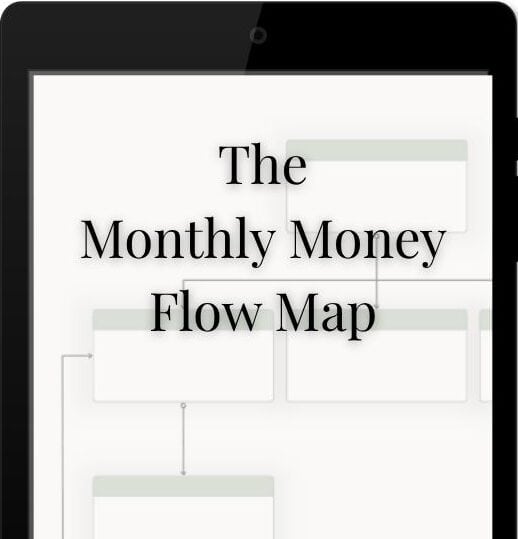
That’s how this four‑step Money Flow System came together. It’s simple, predictable, and designed to support long‑term steadiness to teach you how to organize your finances without turning into another thing you have to manage.
This isn’t a budget. It’s a flow. And it’s built for people who hate thinking about money but also understand the importance of houses and credit scores.

1. Automate Your Savings Before You Ever See It
The first step in learning how to organize your finances is to move decisions upstream of your bank account. There is a reason this is first on the list, it is a simple change that makes a dramatic impact. When money is routed automatically, you don’t have to remember anything or negotiate with yourself later.
Why this matters
When your savings happens before you ever see the money, you’re not relying on motivation or memory. You’re letting the system handle it. It’s the financial equivalent of setting your coffee maker to start on its own.
What this looks like in practice
- 401k Contribution — If you have a difficult time parting with money once it hits your account, raise your 401k contribution instead. Deciding one time in a year to raise your automated contribution is much easier than actively deciding 12 times in a year to put $100 in a savings account.
- Direct deposit splits — You can often split your paycheck to multiple direct deposit locations. This is a great trick for retirement accounts, kids college funds, building a nest egg emergency fund, etc. It serves the same function as a 401k contribution raise for after tax dollars. Decide once to adjust your direct deposit so you don’t have to decide 12 times throughout the year to part with the money.
- Windfall rules — Have the same percentage rule you always follow when you come into extra money (ie. annual bonuses, tax returns, etc) such as half, no matter the amount, always goes towards long term savings. The rest is guiltless fair game. If you are mentally prepared to save half before you ever get the money, making the decision is much easier, since you haven’t spent it all in your head yet.
This step sets the tone for the entire system: clear rules, minimal involvement.
2. Automate Your Bills and Keep All Spending in One Place
Once income is flowing where it needs to go, the next step is creating a predictable monthly routine. You want to know that the essentials are covered without logging into six different accounts. This process for learning how to organize your finances is all about minimalism and making the process as simple as possible. Let the math be done for you, all you have to do it is look at it.
Handling bills
All fixed bills—mortgage, utilities, insurance—are on autopay from the same account. These are the non‑negotiables, so they may as well run themselves. Keep this payment method completely separate from your personal spending (ie. mortgage pulls from debit account, groceries go on the credit card).

How to handle everything else
Every flexible expense goes on a single credit card. Groceries, gas, household purchases, dinners out—everything. When everything else is completely separate from your non-negotiable bills, then the credit card balance you are left with at the end of the month was pure flexible spending that can be tinkered with. You remove the ability to rationalize away a high credit card balance because “its just high because the rent pulls from there too”.
This gives you:
- one clean record of spending
- one balance to check
- one number that tells you if you stayed within limits and is obvious if you start to creep.
At the end of the month, if all non-negotiable bills are automated, the only bill you pay is the credit card, and whatever’s left is the true leftover.
If you can pay the card in full, great. If not, you have one statement to look through to figure out exactly where the month drifted. You’ll notice a pattern quickly when you see the same charges over and over again in the same place.
3. Top Off Your Emergency Fund Before You Touch Anything Else

This is the stabilizing layer—the part that keeps the whole system grounded.
After the bills are paid and the credit card is handled, start by checking one thing:
Is my emergency fund at the level that makes me feel steady?
I am not referring to long term savings, we’ve already automated the long term savings in step 1. This is an “every day emergency” savings. Choose a balance, and keep the expectation permanent, $500, $1000, $3000, $5000, whatever makes you feel comfortable for the “everyday emergencies”.
This is where you go when you run into an unexpected car repair or a vet visit. If you had to dip into this account during the month, top it off first, but only to your pre-selected balance, no more.
You should not be raising this balance above and beyond each month. If you’re already topped off, skip this step entirely.
The goal is to send the bulk of your money to either high interest/long term savings in step one, or to your fun goals in the next step. This account is only an everyday buffer and should not be treated like a savings account without a ceiling.
4. Send Whatever’s Left to Your Goals

Once the essentials and the safety net are covered, whatever remains is true surplus. This is where you get to make progress without budgeting or micromanaging.
I split mine into:
- a slush fund for personal splurges
- a house improvement fund/house down payment
- a vacation fund
Because the system already handled the foundational pieces, this part feels like forward movement—not another task.
How you split the remaining up is completely up to you and your personal goal priorities, but you’ve already done the long term saving up front so this decision can be completely fun and guiltless.
Why This Four‑Step System Works
The order is what makes it powerful:
- Automating savings upfront prevents the need to “decide” to save. It just quietly does it for you.
- Bills pay themselves, and personal spending is easy to identify creep.
- Your everyday emergency fund stays full.
- Your goals grow with whatever’s left.
Learning how to organize your finances doesn’t have to be overwhelming or complicated. With this system, each month you are only making one credit card payment, and one, sometimes two, transfers between accounts. That’s it. It’s a calm, structured way to manage money.
Frequently Asked Questions

Before wrapping up, here are a few quick questions that tend to come up when people start learning how to organize their finances by shifting from “managing money” to “designing a system that runs itself.” These are the ones that matter most at the beginning, and they keep the whole process feeling approachable instead of overwhelming.
How do I start automating my finances if I’ve never done it before?
Start with one upstream automation. That might be setting your 401k to auto‑increase every year or splitting your direct deposit so a small amount goes straight to savings. One change is enough to start shifting your mindset, and it keeps things manageable without adding more “life admin” to your plate. Once your brain realizes how easy it was, you’ll gradually start challenging yourself to dedicate bigger and bigger portions.
Do I still need a budget if I use this system?
Generally speaking, yes. This method for how to manage your finances is simply a process for money flow with what is left over at the end of the month. If your bills run automatically, your spending lives on one card, and your leftover money tells you everything you need to know. If you find that you never have any left over money, or are always carrying a credit card balance, a traditional budget is still useful to reel in or minimize the personal spending so you have something to put towards your goals each month. If you already have leftover money each month and you are happy with your progress rate, then no you do not necessarily need to follow a traditional budget.
How often should I check in on this system?
Once a month. You pay the card, check your emergency fund, and make the fun transfers to move leftover money to your goals. That’s it. The rest runs quietly in the background. I think I log into my retirement accounts once a year at tax time, that’s it, this method of learning how to organize your finances is designed to run on its own.
Customize This System For Your Exact Situation
Designing a system is one thing—having a place to actually map it out is what makes it real. The Financial Shift: Architecture for Everyday Money Management is the complete financial architecture for learning how to organize your finances, the monthly money flow process above, and even a budgeting method with a sustainable way to actually follow it, long term savings automation tricks, and then some. It gives you a guided space to set up your own customized four‑step flow so it’s not just something you understand, but something that supports you month after month.
It walks you through:
- how your paycheck moves from income → bills → savings → goals
- how to track irregular bills like quarterly water bills
- how to check your everyday emergency fund, assign a static balance, and keep it at your comfort level
- how to split your leftover money in a way that matches your real life and feels like making real progress
- how to apply your windfall rules so bonuses and tax returns already have a plan
- how to track your bills so you can identify cable bill or car insurance bill creep
- how to create a budget that actually helps reel in the personal spending, with no math or transaction tracking required
It’s the structure behind the system—the part that keeps everything organized without turning into another ongoing task.
You can get The Financial Shift: Architecture for Everyday Money Management here.



0 Comments